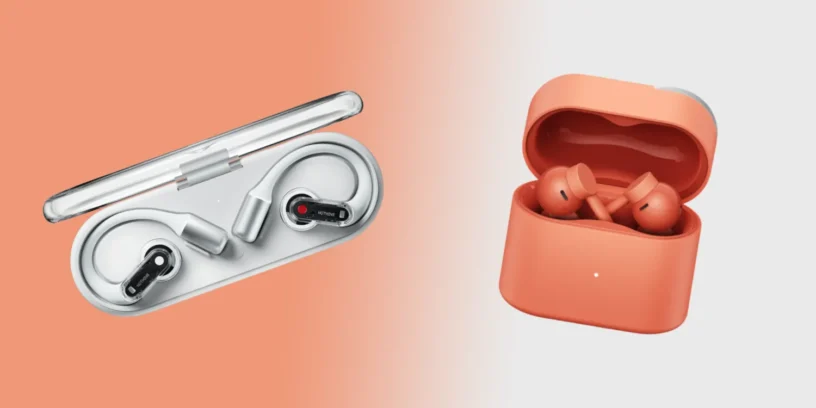
Nothing continues to explore alternatives to traditional in-ear headphones. The convenience of not blocking the ear canal and maintaining awareness of surroundings has driven the development of open-back designs. Within the manufacturer's catalog, we find two very distinct approaches to meet this need: the Nothing Ear (Open) and the very recent CMF Clip Pro. Although they share the premise of not isolating the user from the outside, there are substantial differences in their design, acoustic architecture, and energy performance.
As many of you know, I'm a daily user of the Ear (Open) headphones for work, and I'm truly impressed with their comfort. I hope to bring you a detailed review of the CMF Clip Pro in the coming weeks.
Read the review of the Nothing Ear (Open) headphones – Click here
Design and ergonomics: ear hook versus clip format
The main structural difference between the two models lies in how they fit in the ear. The Nothing Ear (Open) earbuds use an ergonomic stem that wraps around the back of the ear. Measuring 41.4 x 51.3 x 14.4 mm per earbud and weighing 8.1 grams, they provide balanced support. Their charging case has a long, flat shape and weighs 63.8 grams.
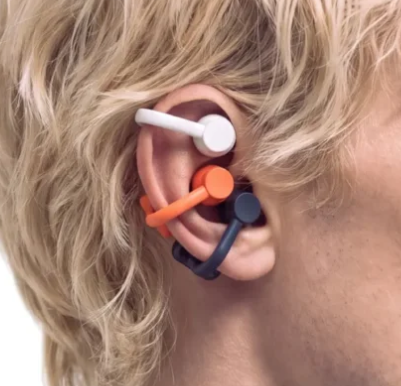
Meanwhile, the CMF Clip Pro earbuds feature a much more compact clip design. Each earbud weighs 5.92 grams and measures 30.75 x 24.84 x 18.21 mm, reducing their overall bulk in the ear. The carrying case complements this miniaturization approach with a more square shape and a weight of 38.81 grams. Regarding resistance to external elements, the Ear (Open) earbuds and case offer IP54 certification. The CMF Clip Pro earbuds maintain IP54 resistance, but their case has an IPX2 rating.

Sound architecture and audio codecs
In terms of acoustics, the choice of components creates distinct dynamics. The Nothing Ear (Open) features a 14.2 mm dynamic transducer with a titanium-coated PET diaphragm, tuned in-house. Signal transmission is limited to standard AAC and SBC codecs via Bluetooth 5.3 connectivity.
The CMF Clip Pro headphones feature a smaller dynamic driver, measuring 10.8 mm and composed of a TPU and LCP diaphragm. However, they compensate for the driver's size by incorporating Bluetooth 5.4 connectivity and support for the high-resolution LDAC codec, backed by Hi-Res Wireless certification. Furthermore, the CMF model adds features such as Static Spatial Audio, dedicated CMF Custom Tuning, and the Malleus algorithm, focused on optimizing bass performance and reducing distortion in the high frequencies.
ADVERTISING
Sound architecture: which should sound best according to your data?
If we analyze the specifications on paper, each model opts for different paths to achieve quality in an open format:
- Physical power and bass: The Nothing Ear (Open) headphones have a clear technical advantage from the start thanks to their 14.2 mm drivers (compared to the 10.8 mm of the CMF Clip Pro). In open-ear acoustics, where sound pressure loss is the biggest challenge, a larger driver is usually crucial for pushing more air, delivering greater volume, and adding more body to the low frequencies.
- Signal detail and fidelity: The CMF Clip Pro, on the other hand, balances the smaller size of its driver with support for the LDAC codec (Hi-Res Wireless certified) and Bluetooth 5.4 connectivity. This allows for the transfer of a greater volume of uncompressed audio data from compatible sources. Furthermore, they counteract the physical limitation of their size with the Malleus algorithm for enhanced bass.
In strict terms of raw power, punch, and natural acoustic presence, the Nothing Ear (Open) should come out on top thanks to the physical scale of their speaker. On the other hand, the CMF Clip Pro theoretically offer a more faithful signal transmission in terms of nuance if you squeeze the LDAC codec with high-resolution files.
Battery management and charging capabilities
Energy efficiency shows an interesting contrast between individual earbud use and charging via the case. The Nothing Ear (Open) earbuds house a 64 mAh battery per earbud and a 635 mAh battery in the charging case. They offer 8 hours of continuous playback (6 hours of talk time), which extends to a total of 30 hours with the charging case (24 hours of talk time). Their fast charging system is particularly noteworthy: just 10 minutes of USB-C connection provides up to 10 additional hours of use.
The CMF Clip Pro earbuds feature 60 mAh batteries in each earbud and a 475 mAh battery in the charging case. This provides extended battery life for the earbuds, reaching up to 10 hours of playback (6.5 hours of talk time). With the charging case's additional charges, the total reaches 32.5 hours of standard use, extendable to 36 hours with extended battery mode activated. Furthermore, their fast charging system delivers 4 hours of use after just a 10-minute charge.
Microphones, calls, and smart features
Voice capture during phone and video calls uses different technologies in each model. The Nothing Ear (Open) headphones integrate AI Clear Voice Technology to dampen ambient noise. Meanwhile, the CMF Clip Pro headphones feature a set of four microphones (two per earbud) supported by a VPU sensor, the Elephant Sound AI algorithm, and VPU Power Call Quality technology.
In terms of smart connectivity, both devices offer support for Google Fast Pair, Microsoft Swift Pair, Dual Connection, and a dedicated low-latency mode to reduce lag when playing games or watching audiovisual content.
ADVERTISING
In calls: which one will best capture our voice?
When examining the clarity of speech and the isolation of ambient noise for our interlocutor, the architecture of the microphones makes notable differences:
- CMF Clip Pro: They incorporate a system of four microphones in total (two per earpiece) combined with a bone conduction/voice sensor (VPU – Voice Pickup Unit), plus the Elephant Sound AI algorithm. The presence of the VPU sensor is a key addition, as it helps isolate voice vibrations directly from the bone structure, reducing the reliance on air microphones in the face of wind or loud background noise.
- Nothing Ear (Open): They use 2 microphones in total (1 per earpiece) along with their AI Clear Voice technology, which processes sound using artificial intelligence algorithms trained to filter out ambient noise during conversations.
On paper, the CMF Clip Pro should offer superior ambient noise isolation and clearer voice capture on calls thanks to the inclusion of the VPU sensor and twice the number of microphones per earbud. However, since this is real-time processing, the final performance will always depend on the firmware calibration and the actual fit in the user's ear, so direct field testing would be necessary to make a definitive statement.
Two clear alternatives for open listening
Both the Nothing Ear (Open) and the CMF Clip Pro offer solid solutions for those looking to listen to music or make calls without being completely isolated from their surroundings. The Nothing Ear (Open) stands out for its larger speaker, incredibly fast charging, and consistent IP54 protection across the entire device. On the other hand, the CMF Clip Pro positions itself as a lighter, clip-on alternative, with LDAC codec compatibility, longer battery life for direct playback, and a very compact charging case.
I hope to test the CMF Clip Pro in the coming weeks so I can give you firsthand feedback on which one sounds better, which earphone has more audio power, which one is more comfortable, and other notable differences.



Leave a Reply